MEMBER PRESS RELEASE - ELODRY® selected for first UK installation as Dŵr Cymru Welsh Water…
Industry calls on Government to use UK-EU carbon market deal to fix biomethane’s treatment in the UK ETS
Industry calls on Government to use UK-EU carbon market deal to fix biomethane’s treatment in the UK ETS
More than 80 businesses and industry figures, including major biomethane producers and UK gas networks, sign open letter to the Energy Secretary and the Chancellor as UK and EU leaders meet in Brussels to seal the link between their carbon markets
More than 80 companies and individuals, including major biomethane producers and the UK’s gas networks, have signed an open letter calling on Government to use the UK-EU carbon market deal to fix a long-standing flaw in the UK Emissions Trading Scheme (UK ETS) that stops heavy industry from cutting emissions with home-grown green gas.
The letter, coordinated by the Anaerobic Digestion and Bioresources Association (ADBA), is addressed to the Secretary of State for Energy Security and Net Zero and the Chancellor of the Exchequer. It comes as UK and EU leaders meet in Brussels today, where they are expected to announce the conclusion of negotiations to link the two Emissions Trading Systems so that UK and EU carbon allowances are mutually recognised. The deal is also expected to pave the way for exempting UK and EU goods from each other’s carbon border taxes.
The UK ETS does not currently recognise biomethane delivered through the gas grid. A UK manufacturer can buy biomethane through the network and still have to surrender allowances as if it were burning fossil gas. Its competitors under the EU ETS can already count grid-delivered biomethane, backed by certified purchase records.
Signatories argue that once the two markets share a carbon price, it makes little sense for the rules on what counts as a zero-emission fuel to differ so sharply. They say the linkage agreement’s own aim of a level playing field for industry should now be applied to biomethane.
Biomethane is a renewable, drop-in replacement for natural gas, made from domestic wastes and residues and flowing through the existing gas grid. For many sites in steel, chemicals, glass, ceramics and minerals, it is the most practical near-term way to cut emissions from high-temperature processes where electrification is not yet technically or economically viable.
The letter says fixing the issue would:
- Remove an unnecessary barrier to business investment in the UK
- Support domestic energy production and energy security
- Give hard-to-abate industries a viable route to reduce emissions while remaining competitive
Signatories say the fix is well understood and can be delivered through the UK ETS monitoring and reporting rules. They urge DESNZ and HM Treasury to treat it as a priority and have offered to meet officials and the UK ETS Authority to take it forward quickly.
Signatories span the biomethane supply chain, from major producers to the gas networks that carry green gas to industrial users and include Acorn Bioenergy, Cadent, Future Biogas, Raft Energy and SGN. The full letter and list of signatories are available here.
Chris Huhne, Chair of ADBA, said:
“Linking the UK and EU carbon markets is a welcome step, and its promise of a level playing field for industry is exactly right. But there is an obvious gap. A British steelworks or glassmaker that buys green gas through the grid gets no credit for it in the UK ETS, while its European competitors already do. Once our carbon prices are joined up, that gap becomes impossible to justify.
“More than 80 businesses and industry leaders, from major biomethane producers to the gas networks, have put their names to this letter because the solution is well understood and ready to go. Government can fix it through the scheme’s monitoring and reporting rules, backing home-grown energy, investment and jobs at the same time. Today’s deal is the moment to get it done, and we stand ready to work with officials to deliver it quickly.”
Sally Brewis, Head of Regional Development, Cadent, said: “Cadent was pleased to sign ADBA’s petition calling for biomethane to be recognised in the UK Emissions Trading Scheme, and we have actively encouraged others across the industry to add their voices to the campaign.
“Biomethane is a proven, homegrown energy solution with the potential to grow tenfold, unlock more than £1 billion of investment and support up to 57,000 jobs by 2050. It offers significant benefits for British industry, farmers and households, strengthening energy security, supporting rural economies and providing a practical route to decarbonisation.
“There is a clear appetite to invest, but Government policy must catch up. Recognising gas network-injected biomethane in the UK ETS would be a vital step in unlocking this opportunity.”
Read the open letter and the full list of signatories
– ENDS –
For further information, contact:
Yamini Talwar, Communications Manager, ADBA
e: yamini.talwar@adbioresources.org; tel: 020 8434 5407
Notes to editors
- The open letter is addressed to the Secretary of State for Energy Security and Net Zero and the Chancellor of the Exchequer. It has been signed by 82 organisations and individuals, including major biomethane producers and UK gas network operators. The full text and signatory list here.
- The UK and EU agreed at their May 2025 summit to work towards linking their Emissions Trading Systems. That Common Understanding also referred to continuing technical regulatory exchanges on energy technologies including biomethane. EU member states approved a mandate to open formal negotiations in November 2025.
- The Prime Minister confirmed to the House of Commons on 12 October 2026 that the UK-EU summit would take place in Brussels on 20 November, with a deal on emissions trading on the table. A draft summit text reported by Euronews says the two sides welcome the conclusion of the linkage negotiations. No date has yet been set for when the link will take effect.
- Under the UK ETS, operators cannot count biomethane bought through the gas grid towards their emissions, so they surrender allowances as if they had burned fossil gas. Under the EU ETS, grid-delivered biomethane backed by certified purchase records can already be counted.
About ADBA
The Anaerobic Digestion and Bioresources Association (ADBA) is the industry association for the UK anaerobic digestion (AD) and biogas industry. ADBA’s vision is to see the full potential of the UK green gas industry realised so it can help the UK achieve its emissions targets and other policy goals, creating a truly circular economy. www.adbioresources.org
About the AD industry
- There are currently over 750 AD plants operational across the UK
- The entire industry digests approximately 36 million tonnes of organic material each year – organic material that would otherwise emit greenhouse gases including highly potent methane, if left untreated in landfill.
- An estimated 21TWh of biogas is produced each year by the AD industry – this green gas is either used to generate electricity and heat via a combined heat and power (CHP) unit or upgraded to biomethane and injected directly into the national gas grid.
- The industry currently delivers savings of 1% off the UK’s greenhouse gas emissions every year.
- An estimated 4,800 people are currently employed in the AD and biogas industry in the UK.
- Overall, the industry grew by 5 per cent last year as the closure of older, smaller plants was outweighed by big-scale units feeding into the gas grid.
- Fully deployed, by 2050, the UK AD and biogas industry is expected to:
- produce over 100TWh of biomethane
- provide between 20% and 50% of UK gas demand
- create 60,000 jobs (30,000 direct and 30,000 indirect).
- save the UK 27 million tonnes of CO2 equivalent – equivalent to taking 1/3rd of all cars off the road
- heat 6.8 million UK homes with the 8 billion m3 of biomethane generated
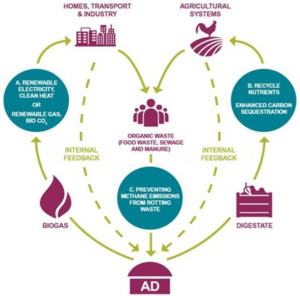
Anaerobic digestion (AD) is the natural breakdown of organic matter in the absence of oxygen in a container called a digester. The process extracts the energy this material contains in the form of biogas leaving the remaining organic matter called digestate – a stable, nutrient-rich substance used as a biofertiliser which restores soil health. Organic wastes typically treated through AD include food waste, animal manures and slurries, other agri-wastes, food & drink processing wastes, sewage sludge.