
MEMBER PRESS RELEASE - Börger’s Crushingly Successful Solution to Septage Intake A Börger Multicrusher has…
MEMBER PRESS RELEASE – Biomethane developers file 38 applications for new or expanded UK plants in first cost sharing assessment window
MEMBER PRESS RELEASE – Biomethane developers file 38 applications for new or expanded UK plants in first cost‑sharing assessment window
“If taken forward, the projects would represent one of the most significant collective expansions of UK biomethane capacity to date.” – Cadent
Thirty‑eight applications have been lodged to build new or expand existing UK biomethane plants, representing one of the most substantial surges yet in new UK capacity of this renewable energy. Cadent, the UK’s largest gas distribution network, is now assessing these applications against its new ‘clustering’ approach. The applications span Cadent’s UK area of operations, with 17 in the East of England, 13 in East Midlands, five in West Midlands and three in the North West.
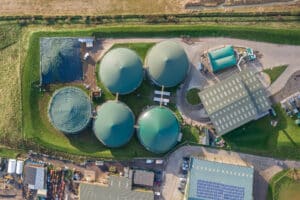
This is the first set of projects to come forward under Cadent’s Ofgem‑supported cost‑sharing model, designed to reduce financial barriers by enabling developers in constrained areas to cluster and share reinforcement costs. If taken forward, the projects would represent one of the most significant collective expansions of UK biomethane capacity to date. Cadent already has 47 biomethane sites connected to its networks, delivering four terawatt hours (TWh) of energy, which equates to the annual gas usage of 351,000 homes. The company is aiming to grow this to 20TWh by 2035 – the annual gas usage of 1.8 million homes.
Biomethane is renewable energy because it is derived from continually replenished organic materials, including agricultural residues, sewage and food waste. It is increasingly seen as one of the practical, near-term options available to support the UK’s wider transition away from fossil-based energy sources.
Howard Forster, Chief Operating Officer at Cadent, said: “Biomethane is a proven technology – it’s here now, delivering real carbon savings today, and it will be a major part of our energy future. To see 38 applications arrive in this first window shows the level of confidence developers have in the sector and in the new approach we’ve introduced. This is one of the strongest indications yet that the market is ready to grow at scale.
Our cost‑sharing, clustering model is doing exactly what it was designed to do: removing barriers, driving coordination, and helping more projects progress. We’re committed to working with developers to turn as many of these applications as possible into operational plants supplying low‑carbon biomethane into our networks.”
Cadent’s Network Analysis teams are now reviewing the applications to identify opportunities for clustering and to confirm reinforcement requirements at each location. Developers will receive indicative reinforcement costs in the coming weeks before choosing whether to progress to the next phase.
The company says the response demonstrates strong, sector‑wide momentum behind biomethane and the effectiveness of targeted reforms in unlocking new renewable gas capacity. Earlier this month, Cadent confirmed that the cumulative amount of biomethane to enter its gas pipeline network – since the first of the 47 plants came online in 2013 – had exceeded 1.5 billion cubic metres.
Although the first application window is now closed, Cadent plans to hold more. Developers can make contact with Cadent at unlockingbiomethane@cadentgas.com to register interest. Information is also available at www.cadentgas.com/bioentry
Background on biomethane in the UK
Growth in biomethane is essential to achieving a balanced, sustainable approach to the UK meeting net zero and its future energy needs.
Produced from organic waste streams – such as food, manure, waste water and other feedstocks – biomethane today contributes around 7TWh to the UK’s energy supply. More than half (4TWh) is connected into the four networks that Cadent manages, which is equivalent to 351,000 homes heated.
Cadent is aiming to significantly increase this, reaching 20TWh in its four networks by 2035 (equivalent to 1.8 million homes heated).
Current biomethane producers range from individual landowners installing a plant on their farm, to large multinational developers managing portfolios of sites. Both existing biomethane producers seeking to expand, and entirely new sites, can benefit from the new network charging arrangement and ‘clustering’ approach.
A major shift away from “first‑connector pays”
Until now, where network capacity is constrained, the first biomethane developer triggering a reinforcement was required to fund the full cost of making it happen, including wider system upgrades. This was a financial barrier that is known to have stalled or even ended many otherwise viable biomethane projects.
Following extensive industry engagement and developer feedback, Ofgem has supported Cadent’s proposal to overhaul these charging arrangements.
Under the new model, where reinforcement of the gas network is required to enable a biomethane connection, the developers of that site can get up to £2 million towards the cost. This is a “use-it-or-lose-it” (UIOLI) allowance included in Ofgem’s RIIO-3 Final Determinations for gas distribution networks.
In addition, where more than one project can come together to create a local ‘cluster’ or group of new sites, any costs above £2 million per connection can now be shared between developers.
This is a major shift from the current biomethane model, where the first developer to connect to the network bears the full cost of that reinforcement. By sharing the cost, it reduces the pressure on the first developer wanting to connect to the network and creates a fairer process
-ENDS-
About Cadent
 Cadent is the UK’s largest gas distribution network with a 200-year legacy. We are in a unique position to build on strong foundations whilst encouraging the curiosity to think differently and the courage to embrace change. Day to day we continue to operate, maintain and innovate the UK’s largest gas network, transporting gas safely and protecting people in an emergency. Our skilled engineers and specialists remain committed to the communities we serve, working day and night to ensure gas reaches 11 million homes from Cumbria to North London and the Welsh Borders to East Anglia, to keep your energy flowing. www.cadentgas.com
For further information, contact:
Kevin Hegarty
kevin.hegarty@cadentgas.com; 07970 694897
