
MEMBER PRESS RELEASE - Pump success move as Börger UK continues to grow Börger UK,…
Green Gas industry body launches manifesto to support sector ahead of Scottish Parliamentary Elections
Green Gas industry body launches manifesto to support sector ahead of Scottish Parliamentary Elections
- Anaerobic Digestion and Bioresources Association (ADBA) launched its Green Gas Manifesto at the ADBA Scottish Conference 2026 in Edinburgh yesterday.
- Ahead of the Scottish Parliamentary Elections in May, the manifesto sets out a framework for action with clear policy pillars and calls to action to mobilise government, industry, finance and communities towards a shared national mission.
- The conference was attended by Gillian Martin MSP, Cabinet Secretary for Climate Action and Energy for the Scottish Government, Emma Harper MSP, Co-Convener, Cross-Party Group on Rural Policy in the Scottish Parliament and Emma Roddick MSP, Highlands and Islands and member of the Rural Policy group.
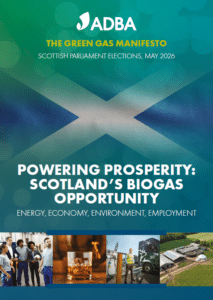 At its Scottish Conference in Edinburgh yesterday, the Anaerobic Digestion and Bioresources Association (ADBA) presented its Green Gas Manifesto designed to steer Scotland’s future policy towards reaping the benefits of investing into biogas technology in the country.
Entitled ‘Powering Prosperity: Scotland’s Biogas Opportunity’, the manifesto highlights how anaerobic digestion (AD) and biogas are uniquely positioned among renewable technologies to:
- provide dispatchable, controllable energy that supports grid stability and energy security,
- deliver one of the highest carbon savings ratio of any low carbon technology available,
- enable deep decarbonisation of hard-to-electrify heat, transport and industry sectors,
- produce a biofertiliser – digestate – that restores soil health, reduces fertiliser imports and cuts emissions from agriculture, and,
- support economic growth and job creation.
With rising geopolitical risk, volatile energy markets, fertiliser price shocks and accelerating climate impacts, ADBA advocates for any new Scottish Government after the May elections – to act immediately and establish green gas and biofertiliser from AD as part of its core national infrastructure to ensure domestic energy and climate resilience, improve soil health, meet net zero ambitions and achieve long term rural prosperity.
The industry body also provides clear policy actions and targets around biomethane production, the reduction of synthetic fertiliser use, carbon abatement and investment.
This includes the possibility of saving the equivalent of one million short haul return flights’ worth of carbon with the adoption of a digestate first fertiliser plan, and carbon removals similar to the planting of quarter of a billion trees across Scotland.
“This manifesto sets out a road map for any future Scottish Government to see the sector succeed” explained Cameron Ball, ADBA External Affairs Lead, at the conference, “This can be achieved by backing small on-farm systems with a £50m fund, recognising the value of digestate as a bio-fertiliser, and taking into account the full potential of AD and biogas in all future carbon and energy plans.
If the Government does this, we could see more than 25% of Scottish Gas supply being met by biomethane, and a 50% reduction of synthetic fertiliser – producing massive carbon savings and keeping more than £40m in the Scottish economy.
We encourage all candidates and parties in the weeks leading to the 7 May election to read and support our manifesto and our calls for action. ADBA looks forward to working with the 129 MSPs that will be elected and the future Scottish Government.”
– ENDS –
For further information, contact:
Jocelyne Bia, Head of Corporate Communications, ADBA
e: jocelyne.bia@adbioresources.org; tel: 020 3176 0592
Notes to editors
About ADBA
The Anaerobic Digestion and Bioresources Association (ADBA) is the industry association for the UK anaerobic digestion (AD) and biogas industry. ADBA’s vision is to see the full potential of the UK green gas industry realised so it can help the UK achieve its emissions targets and other policy goals, creating a truly circular economy. www.adbioresources.org
About the AD industry
- There are currently over 750 AD plants operational across the UK
- The entire industry digests approximately 36 million tonnes of organic material each year – organic material that would otherwise emit greenhouse gases including highly potent methane, if left untreated in landfill.
- An estimated 21TWh of biogas is produced each year by the AD industry – this green gas is either used to generate electricity and heat via a combined heat and power (CHP) unit or upgraded to biomethane and injected directly into the national gas grid.
- The industry currently delivers savings of 1% off the UK’s greenhouse gas emissions every year.
- An estimated 4,800 people are currently employed in the AD and biogas industry in the UK.
- Overall, the industry grew by 5 per cent last year as the closure of older, smaller plants was outweighed by big-scale units feeding into the gas grid.
- Fully deployed, by 2050, the UK AD and biogas industry is expected to:
- produce over 100TWh of biomethane
- provide between 20% and 50% of UK gas demand
- create 60,000 jobs (30,000 direct and 30,000 indirect).
- save the UK 27 million tonnes of CO2 equivalent – equivalent to taking 1/3rd of all cars off the road
- heat 6.8 million UK homes with the 8 billion m3 of biomethane generated
Anaerobic digestion (AD) is the natural breakdown of organic matter in the absence of oxygen in a container called a digester. The process extracts the energy this material contains in the form of biogas leaving the remaining organic matter called digestate – a stable, nutrient-rich substance used as a biofertiliser which restores soil health. Organic wastes typically treated through AD include food waste, animal manures and slurries, other agri-wastes, food & drink processing wastes, sewage sludge. If such wastes are not treated, they emit methane, pollute rivers and oceans, and cause other environmental and human health issues. Humans generate over 105bn tonnes of such organic wastes annually, which contain around one third of today’s fossil gas demand.

