


MEMBER PRESS RELEASE - Realistic Agri strengthens biogas team with appointment of Ross Henderson Realistic…
MEMBER PRESS RELEASE: Roadgas Unveils UK’s First National Bio-LNG Refuelling Network
Roadgas Limited is rolling out a national network of Bio-LNG refuelling stations to serve the UK haulage sector.
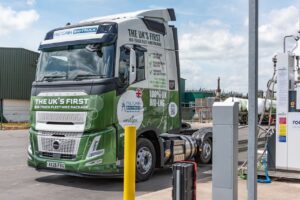 This network will enable heavy goods vehicles to fuel with renewable biomethane (Bio-LNG) at motorway forecourts and depot sites and cutting fleet CO₂ emissions by over 80% compared to diesel. Fleets will benefit from lower fuel costs versus diesel, long driving ranges (~1,000 km per tank) and fast,24/7 access.
Roadgas is installing 12 new Bio-LNG stations across key freight routes throughout 2026 on behalf of Pretoria Energy, the UK’s largest bio-LNG supplier based in Cambridge. The joint Roadgas Pretoria
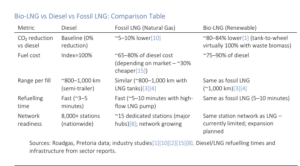
offer will deliver flexible payment models (including pay-per-mile) as well as OEM support (maintenance and diagnostics) to maximise uptime for fleets. A detailed comparison (below) shows
Bio-LNG’s environmental and cost advantages over diesel and fossil LNG.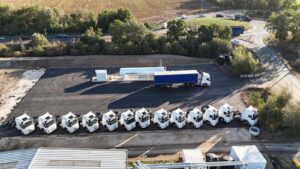
The new station rollout will bring Bio-LNG to strategic motorway corridors and depot locations, giving haulage operators access to a truly low-carbon fuel.
“Roadgas is committed to fuelling greener fleets,” said David Rix, Managing Director of Roadgas. “By combining biomethane with expanded refuelling sites, we are delivering a transparent solution for UK haulage. Operators can track the fuel’s journey from organic feedstock all the way to the truck’s tank”
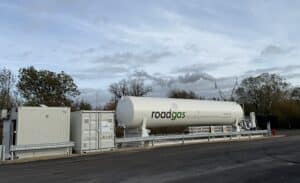
The Bio-LNG network will include both public-access stations (open 24/7 to any HGV) and private depot sites. Each facility is equipped with high-flow cryogenic dispensers and large-capacity LNG tanks,
enabling refuelling times of only a few minutes per truck. Key freight routes from the Southeast, Midlands and North will be served, with more stations coming online through 2027. Roadgas is initially
deploying 12 new Bio-LNG stations – roughly doubling UK heavy-fuel gas access– with plans for additional sites as the market grows. All stations are designed for HGV driver safety and many are co
located with diesel forecourts, onsite facilities or fleet depots to ensure convenient access.
The environmental benefits are substantial. Bio-LNG (renewable biomethane) cuts lifecycle CO₂ emissions by ~80% compared to diesel with near-zero tailpipe CO₂ if combined with green fuel. Bycontrast, conventional fossil LNG offers only modest CO₂ reductions typically ~5–10% lower than diesel – and even this requires upstream energy for liquefaction. In practical terms, Roadgas estimates BioLNG delivers over 80% CO₂ savings versus diesel, plus a ~94% drop in particulates and NOₓ. Fuel cost savings are also compelling: In today’s market, Bio-LNG runs 10–25% cheaper per litre/kWh than diesel[2] (industry data suggests similarly steep savings for pure LNG[11]), easing pressure on operator margins.
The new network leverages proven gas trucks. These 460hp vehicles deliver diesel-matching performance up to 2,500 Nm torque and offer a range of up to 1,000 km on LNG/Bio-LNG, ideal for
long-haul operations. Thanks to an authorised service network, all Bio-LNG trucks benefit from gold standard maintenance, genuine OEM parts and advanced diagnostics – ensuring high uptime and
safety.
Bio-LNG stations use standard safety protocols. The fuel meets ISO standards for LNG fuel quality(typically >97% methane) and can be used in gas-compatible engines without modifications. Its
cryogenic storage requires industry-accepted safeguards (double-walled tanks, vapor recovery, etc), all of which Roadgas fully implements. Rigorous site design and emergency systems ensure safe 24/7operations.
 Roadgas offers these stations alongside flexible commercial options supported by Pretoria Energy Group Limited. Fleets can choose pay-per-mile contracts or bulk fuel pricing. A new pay-per-mile truck
package “Bio-Truck” is already available, bundling a Bio-LNG truck, maintenance and fuel in a simple pence-per-mile fee. Contract lengths of 5–7 years align with fleet renewal cycles and operators gain dedicated support (fuel logistics, site monitoring etc) as part of the Roadgas Pretoria full-service proposition.
“This network puts Bio-LNG stations on the map for UK hauliers,” said Roadgas MD David Rix. “By expanding beyond isolated sites, we’re making low-carbon gas an accessible, mainstream fuel for
freight. Now fleets can earn their ESG stripes with real, measurable emission cuts.”
Heavy fleet operators are invited to learn more about upcoming station locations and fuelling contracts. Visit roadgas.co.uk to arrange trials or on site assessment
–ENDS —
About Roadgas:
Founded in 1992 in Nottingham, Roadgas is a key supplier of gas and biomethane vehicle refuelling station infrastructure and equipment. Boasting over a quarter of a century of experience supplying numerous bespoke CNG (grid gas), LNG (Liquefied Natural Gas) and LCNG (Liquefied to Compressed Natural Gas) installations around the country, Roadgas provides tailored solutions to small, medium and large fleet operators throughout the UK.
Roadgas is an active member of LowCVP, BCGA, IGEM and ADBA.
Note to Editor:
For more information on Roadgas, please visit www.roadgas.co.uk.
For further content and imagery, please contact:
Becky Rix, Marketing Director Roadgas Limited T: 0115 822 5530 E: beckyrix@roadgas.co.uk
Catherine Rix, Marketing Manager Roadgas Limited T: 0115 822 5530 E:catherinerix@roadgas.co.uk
Key Messages & Facts
• Carbon reduction: Bio-LNG (biomethane) cuts lifecycle CO₂ emissions by ~80–84% vs diesel[1] (plus ~94% lower NOₓ/particulates). Fossil LNG delivers only ~5–10% CO₂ savings[10].
• Fuel cost: Bio-LNG is ~10–25% cheaper than diesel[2]. European data suggest LNG options can cost 30–35% less than diesel[15]. Lower fuel prices substantially improve TCO for HGV fleets.
• Driving range: Diesel and gas trucks are comparable. Gas trucks can cover up to ~1,000 km per tank[3][4], matching typical diesel ranges. Tank configuration (gas volume) is key.
• Refuelling time: Diesel pumps refuel in ~3–5 minutes. Cryogenic LNG/Bio-LNG fuelling typically takes ~5–10 minutes for a full HGV fill (fast-flow pumps) – still quick and akin to diesel stops.
• Infrastructure: UK currently has only ~15 dedicated LNG/Bio-LNG stations[8], vs ~8,000 diesel stations. Pretoria Roadgas’ rollout (phase 1: [X] new stations, site types to include motorway forecourts, truck depots and 24/7 public locations) will dramatically expand coverage on key M-Routes (M1, M6, etc.).
• Station types: The network will feature public-access sites (with all-hour card payment) and private consortium depots. Each HGV pump handles high flow (30+ kg/min) allowing simultaneous multi-truck fuelling. HGV parking/storage available on large sites.
• Payment models: Roadgas offers both traditional fuel pricing and innovative pay-per-mile schemes (like Bio-Truck). Pay-per-mile bundles truck lease, maintenance and fuel into one pence-per-mile fee[14] for budget certainty.
• Maintenance & OEM: Bio-LNG trucks are covered by an authorised service network. Genuine OEM parts and diagnostic support ensure uptime comparable to diesel fleets[16]. Roadgas also provides remote station monitoring and on-site servicing for facilities.
• Safety & Compatibility: Bio-LNG uses the same infrastructure/engines as LNG. Fuel meets ISOgas-quality standards; engines need no special mods beyond normal diesel/gas calibration. Standard cryogenic safety protocols (insulated tanks, venting, leak detection) ensure secure operations, on par with any commercial LNG site.
[1] Biomethane Infrastructure & Gas Supply | Roadgas https://roadgas.co.uk/
[2] [3] [14] [16] Pretoria Roadgas Launches The UK’s First Pay‑per‑mile Bio‑Truck | Truck News | Truckpages UK https://www.truckpages.co.uk/news/fuel-type/lng/pretoria-roadgas-launches-the-uks-first-pay-per-mile-bio-truck/
[4] [9] [12] gas-powered truck https://www.volvotrucks.com/en-en/trucks/gas-powered/volvo-fh-aero-gas-powered.html
[5] [6] [7] Advanced BioFuels USA – Strategic Acquisition Will Speed up Decarbonization of UK Heavy Transport Fleets with Biomethane
https://advancedbiofuelsusa.info/strategic-acquisition-will-speed-up-decarbonization-of-uk-heavy-transport-fleets-with-biomethane
[8] Infrastructure Map UK – Gas Vehicle & Hydrogen Refuelling Stations | GV Network https://gvnetwork.co.uk/infrastructure-map-uk
[10] [11] [15] Comparison of Carbon-Dioxide Emissions of Diesel and LNG Heavy-Duty Trucks in Test Track Environment | MDPI https://www.mdpi.com/2571-8797/6/4/70
