
MEMBER PODCAST - Biochar and the future of carbon credits An episode from the Carbogenics…
MEMBER PRESS RELEASE (Product Profile) – Not all gas coolers are equal
MEMBER PRESS RELEASE (Product Profile) – Not all gas coolers are equal

By Matt Hale, Global Business Development Director, HRS Heat Exchangers
Whether you want to recover waste heat from exhaust gases or remove moisture from biogas to improve plant performance and operational longevity, various designs of heat exchanger are available. However, these gas mixtures are often highly corrosive, meaning that when comparing possible heat exchanger or dehumidification systems, it is important to consider the design and materials used to ensure the chosen equipment lasts as expected.
Exhaust gas heat recovery has become common in many industries, providing both cost savings (the recovered energy can be used for process or space heating elsewhere in the plant) and environmental benefits (both by reducing emissions such as nitrogen oxides, but also by reducing carbon footprints). With as much as 35% of an engine’s fuel being wasted as exhaust heat, there can be considerable savings to be made from fitting exhaust streams or flues with heat exchangers, meaning that the initial capital outlay can quickly be recouped.
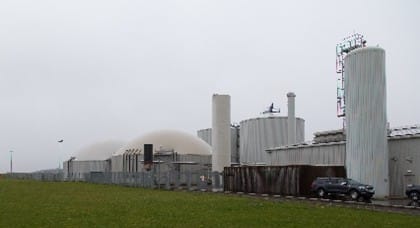
Similarly, as the global use of anaerobic digestion has increased, so too has awareness of the issues caused by the water contained in biogas, such as corrosion and cavitation in CHP engines and generators. As a result, HRS Heat Exchangers has seen increased demand for its Biogas Dehumidification System (BDS), which removes this water and recovers heat to increase the overall energy efficiency of an AD plant. The same benefits are also seen in plants generating power from captured landfill gas.
Both raw biogas and exhaust gas contain a mixture of different compounds, from relatively inert substances like as carbon dioxide and nitrogen to oxides of nitrogen and sulphur, and siloxanes (which can react to form highly corrosive or abrasive materials) and organic compounds, particulates and heavy metals (which can increase the fouling potential of the gas).
Unless a heat exchanger or other system has been specifically designed for use in such aggressive situations, it can quickly succumb to fouling, corrosion or complete failure. At best this means lower operating efficiency, and in the worst cases that such heat exchangers will need replacing sooner – possibly after months instead of years.
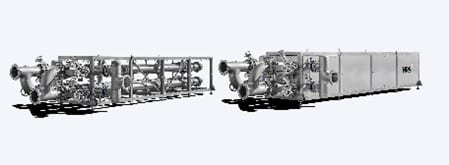
Unlike cheaper heat exchangers which are constructed from carbon steel, the HRS K Series and G Series of Gas Cooling Heat Exchangers are constructed from AISI 304 and AISI 316L stainless steel to withstand corrosion and utilise our corrugated tube technology which increases heat transfer and reduces fouling.
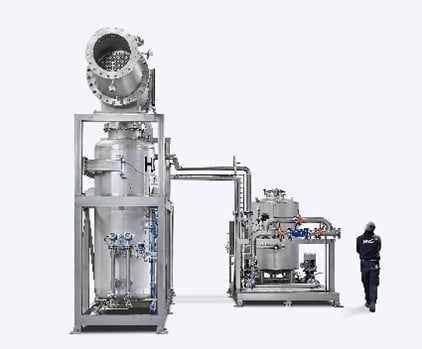
This means that in practice we have seen the HRS G Series last 3- or 4-times longer in aggressive operating environments compared to lower cost carbon steel heat exchangers.
For example, LMS Energy generate more than 550,000 MW of baseload power each year from 60 biogas sites around Australia. Since 2018 they have utilised stainless steel HRS K Series corrugated shell and tube heat exchangers to dehumidify the landfill gas before it is used for energy generation in containerised Jenbacher generator sets.
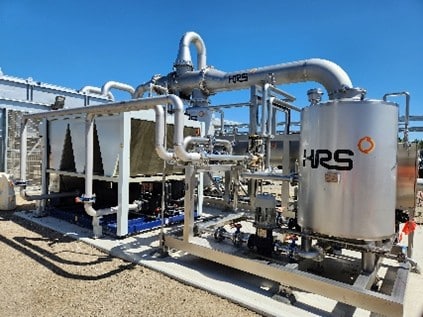
In another installation, we supplied a Biogas Dehumidification System (BDS) as part of an upgrade to Melbourn Melbourne Water’s Eastern Treatment Plant in Australia – the largest activated sludge plant in the Southern Hemisphere. In this case the BDS needed to meet the requirements of two different operational stages, each of which contained four duty requirements. This meant a complex thermal design process was necessary to make sure that the supplied unit could meet all eight of the potential design scenarios.
With systems for digester heating, pasteurisation, digestate concentration, biogas dehumidification, and sludge and exhaust gas heat recovery. HRS equipment is installed at more than 200 biogas plants worldwide, helping operators to improve their efficiency and overall operation.
-ENDS-
About HRS Heat Exchangers
Located in the UK, HRS Heat Exchangers is part of the EIL Group (Exchanger Industries Limited) which operates at the forefront of thermal technology. HRS offers innovative heat transfer solutions worldwide across a diverse range of industries. With more than 40 years’ experience in the environmental and energy sectors, specialising in the design and manufacture of an extensive range of turnkey systems and components, incorporating our corrugated tubular and scraped surface heat exchanger technology, HRS products are compliant with global design and industry standards. HRS has a network of offices throughout the world: Australia, Canada, UK, Spain, USA, Malaysia and India; with manufacturing plants in India, Spain and Canada.
Email for publication: info@uk.hrs-he.com
For UK media enquiries about HRS Heat Exchangers, please contact
Bev Small, FastLoop Media
T +44 (0) 7901 841491 E bev@fastloopmedia.com
Kate O’Reilly, FastLoop Media
T +44 (0)7894 039 609 E kate@fastloopmedia.com
W www.fastloopmedia.com
